Showing posts with label safety. Show all posts

Stop the Child Murder

Here is a great piece on how Dutch citizens were able to force their government to promote cycling: Stop the Child Murder.

In case you didn't know, the Netherlands has the highest cycling rate in the world. Around 30% of Dutch adults always ride their bike to work, and around 40% sometimes do. In fact, there are more bicycles in the Netherlands than there are people. And, in Amsterdam, more trips are made by bike than car.  Bicycle is a preferred method of travel.

But this wasn't always the case.  While cycling was popular before World War II, apparently the government--like governments worldwide--began to favor cars in infrastructure planning. As a consequence, but not a surprise, the number of deaths increased, including among children. Out of protest, the "Stop the Child Murder" group formed and advocated for policy and infrastructure changes that made bicycling safer, particularly for children.

This is another way of looking at advocacy for new and safer infrastructure, as the article points out. Instead of cyclists advocating for cyclists, maybe the solution is to advocate for safer travel for children.  American ideas of safety always go back to personal and individual choices--like wearing helmets--that are unproven or that make little difference.  We tend to react distastefully to ideas of government promotion of anything.  The fact remains, however, that the Netherlands and other European countries have much better health outcomes, lower rates of obesity, and higher levels of happiness than we do in the United States. 


Wearing a helmet will not make a child safer, at least not as safe as providing a segregated lane or bike path will.  And until we begin to provide the infrastructure, parents will not feel safe sending their kids out on the roads to ride.  Perhaps it's time to reframe our arguments.

Why Bloominghagen?

What right-minded town wouldn't want to emulate Copenhagen? Here is a wonderful video to demonstrate why:


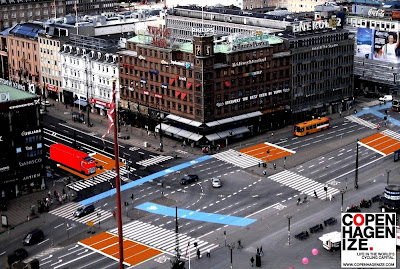
As part of my role as a commissioner on the Bicycle and Pedestrian Safety Commission, I have advocated for segregated bike lanes and identifiable paths (including colored lanes) that run through intersections. These measures would drastically increase the safety of bicyclists because they would be separated from traffic and more visible when crossing intersections.

Wouldn't it be nice if Bloominghagen looked like this?


(Thanks to Mikael at Copenhagenize for his images, videos, and, well, leading the advocacy for this cause)

Risky Business

To don, or not to don (helmets), that is the question.


For many people, the instinctive response is to don. And not just to make that personal choice, but to lecture heavily those who do not. But are helmets the ultimate safety gear, or do they offer only the perception of safety? You may be surprised at the answer.

Over the last several years (or 20 or so), helmets have been promoted and in many cases have been mandated. Promotion of helmets has been backed with statistics about the number of head injuries or how many deaths are prevented with the light piece of plastic on one's head or anecdotal evidence of so-and-so who almost died and surely would have had he not been wearing his helmet.

Unfortunately, the data are not that clear. Research has not shown definitively that helmets save lives. The evidence, researchers have found, is inconclusive and contradictory. Part of the problem is the difficulty of doing studies on cyclists. Bicycling, in general, is not a risky endeavor, and very few injuries result, particularly compared to pedestrians and motorists.

Moreover, helmet-related studies have often been "case-controlled" studies, which compare a group of cyclists who had head injuries and one or more groups without head injuries. The problem with these types of studies is that suitable control groups are not always available. Other problems include the difficulty of adjusting for other differences between the head injury group and the non-head injury group (aside from the difference the researchers are looking for: helmet use). Studies have shown that cyclists who wear helmets may be more safety-conscious and follow the rules, which would result in fewer injuries (although, other studies have shown that they also tend to crash more). Also, in one study, helmet-wearers tended to be adult and female (and more responsible) and the non-helmet wearers were children and male (and more likely to take risks).

Another common study, the time-trend analysis, studies injuries over time in places where helmet use is required. The benefit of these types of studies seems to be debatable, as scientists do not agree on the criteria that should be used.

Additionally problematic are the anecdotal evidence ("My life was saved by a bicycle helmet."). Well, it's really quite difficult to say that for sure, isn't it?

In fact, for the casual, commuting or recreational cyclist, the studies do not demonstrate that helmets prevent head injuries. Helmets will, at most, prevent head injuries for high speed crashes of the sort that occur in bike races. At lower speeds, which is the speed most people ride around town, most cyclists will fall and hit their arms or their legs. Furthermore, in an accident with a car, no bicycle helmet will help--they aren't designed to.

(Here is a piece of anecdotal evidence. In the years I raced competitively--not including triathlons--1993-1999, I went to the hospital 3 times for bike wrecks, including a high speed wreck in a race where I slid across the road and hit the opposite curb with my back. I also had many, many other additional crashes. Not once did I have a head injury. But both my hips and knees still carry remnants of asphalt)

The thing we have learned is that mandating helmet use seems to make cycling safer in one way: it discourages people from riding their bikes. If you don't ride your bike, you can't hurt your head in a bike wreck. At least one study (pdf) has found that when helmet laws were mandated in Australia, a significant number of people stopped riding.

Studies of other mandated helmet laws found similar trends--that the number of head injuries declined, but so did the number of other non-head injuries, meaning that the reduction of head injuries was probably related to a reduction in bicyclists. Teenagers, in particular, were more apt to abandon the bike. Helmets are hot and sticky, and they are difficult to secure to a bicycle when the bicycle is parked (the other, more annoying, option being hauling the helmet with you). These are disincentives to wearing a helmet, and, when helmets are mandated, a disincentive to riding a bike.

AND fewer people on the roads actually make it more dangerous for others, as there is safety in numbers.

As the helmet debate probably will not provide a conclusive answer anytime soon, advocates of safe cycling need to focus on the real dangers cyclist face: the automobile. Instead of requiring cyclists to don a helmet, cities should provide the infrastructure to protect cyclists from cars and to make cars aware of cyclists' presence. This includes providing more and better bike lanes that are segregated from traffic; painting those lanes that cross intersections bright, bold colors so drivers can see bike lanes and cyclists; and creating separate turning lanes for cyclists. Additional education for young riders on safety rules would help them protect themselves in traffic.

Bicycling is a healthy mode of transportation. Getting more people on bikes could help clear the air of pollution and minimize our ever-expanding waistlines. Preaching about helmet usage, however, has the opposite effect. It makes cycling seem dangerous when it really isn't. Helmets have not been found to provide the safety that their promoters declare, and such preachiness will only serve to reduce the numbers of people getting out on their bikes. Helmet usage should remain a personal decision (so thank you for no longer preaching to me).

Some additional reads:
Dutch Cycling Union's Position
Icelandic Cycling Union's Position
European Cycling Federation's Position
Helmet use for Pedestrians
Seat Belts vs. Helmets

Parents and children

Bloomington parents enjoy taking rides with their children. Our bike culture is not as developed as certain Northern European countries, but we're getting there.


And this is the goal. I first saw this video on Copenhagenize. This is a typical morning in the Netherlands--parents dropping their kids off at school. As Copenhagenize says: normal people in normal clothes doing normal things on their bikes. Enjoy!

Commuting Through Bloomington Safely: Part II

The benefits of having citizens travel by bike instead of cars are fairly well known and include less traffic congestion, decreased pollution, and increased safety for pedestrians. Benefits also include a more vibrant and active city center and higher profits for businesses (as cyclists make better shoppers than drivers).

And though it is a laudable goal to "encourage" people to ride their bikes to work or the store or to shopping and shows, many people fear riding their bikes through traffic. So, in order to gain the benefits of bicycles, the city needs to take affirmative steps toward getting people on their bikes. The single most effective way to do this is to make riding safer. And the single most effective way to make riding safer is to get more bikes on the road. hmmm....

Clearly, something else must be done to increase safety. In a previous post (Part I), I explained what the city could do better to make cycling safer around town. The proposals included adding more bicycle lanes, segregating bicycle lanes from traffic, and avoiding the "disappearing bike lane" at stoplights.

Although Bloomington has much to be chastised for regarding a lack of safety infrastructure around town, bicycle safety cannot be put wholly in the hands of city officials. Commuting safely through Bloomington also requires smart bicycling, and obeying traffic laws. It may appear that an idiot bicyclist (and I'm just going to call a spade a spade here because I think they are idiots) who refuses to obey the rules of traffic puts only himself at risk, but--alas--such is not the case.

The benefit of traffic laws is their gift of predictability. In other words, you, as participant in traffic, generally understand that others will be following the same rules as you, and thus you can predict with some accuracy what other vehicles will do in any given situation. This allows you to anticipate events and react accordingly. Hence, if you, driver, pull up to a four-way intersection where other cars have already stopped, you realize that there is some order to which each car will leave the intersection. And, if you are driving down a one-lane road, you have a justified expectation that vehicles will not be careening toward you.

All of these rules guarantee a degree of safety for you and for others. And the same must hold true for bicyclists. No good is served when a cyclist determines to make his own traffic rules. Such actions confuse drivers, who have no way of predicting what a cyclist will do, and diminishes safety for other bicyclists.

A case in point: many bicyclists seem to think that those red octagonal signs that say STOP in big, white letters do not apply to them. So when cars arrive at intersections where bicycles have also arrived and where both are supposed to stop, drivers are not sure whether they should procced when they have the right of way or wait and see what the bicycle will do. This causes also sorts of madness and frustration for everyone.

The three main violations I see around town that wreak havoc on predictability (and car, bicycle, and pedestrian safety) are: (1) riding the wrong way on one-way streets; (2) running not only stop signs but also traffic lights; (3) and riding on the sidewalk.

One-Way Streets:

You, who feel so inclined, I think you are just big jerks. I don't think I need to spell out why this is dangerous and selfish.


And it is not dangerous only to the idiot riding the wrong way. You also put me in danger because I have to worry about my safety from cars AND from you. Explain to me, sir, how we are both to fit in this narrow lane going in opposite directions? (I can't even get a clear shot from this direction)

Running Red Lights

This might seem like not such a big deal, right? When the intersection is clear, why not just ride straight through?

Look, bicycles are not children's toys. They are vehicles. They are modes of transportation. And, as such, they must obey the rules of the road. This is not just an inclination or feeling that I have. It is the law (an unenforced law, but still). The only way to improve safety for cyclists is for cyclists to be respected as equals of other vehicles. And the only way for that to happen is if we respect the rules of the road.

Riding on Sidewalks

Aside from the short (and slow) sidewalk trips that are required to arrive at the bike rack, rides on sidewalks are no-nos. Roads are for bicycles; sidewalks are for pedestrians. Otherwise, it is just dangerous for both. Not to mention rude.


Not even trees in the middle of the sidewalk can stop these intrepid bikateers!
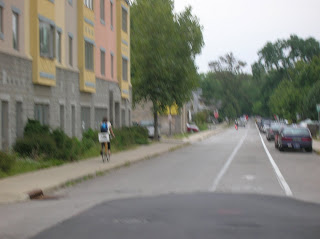
bike lane, schmike lane.


Look, I'm not a saint. I've broken my share of traffic laws both in a car and on a bicycle. But I endeavor to ride my bike as I drive my car--obeying laws as much as I can humanly withstand. My general rule, and perhaps this can be a rule for us all: ride your bike as you would drive your car. And if you drive your car through red lights, the wrong way down one-way streets, and on sidewalks, there's not much more I can say.

Commuting Through Bloomington Safely: Part I

Fear and a lack of safety are the most common reasons I hear for people not riding their bikes in Bloomington. And, really, I can't blame those who feel unsafe on Bloomington's roads. The town has not encouraged bicycling by incorporating bicycle infrastructure into its planning in any significant way.

The only bike lanes of consequence in town run on North-South roads. But a large number of residents live to the East and West of downtown. For those who live on the far East side of Bloomington, the only way to commute by bike to downtown would be to ride on the narrow and busy 10th and 3rd streets or to ride through Indiana University's campus (and, really, what adult wants to be reminded of the fact that the incoming freshman were born in 1990? As if aging weren't hard enough). IU's campus is not exactly the easiest to traverse on bike because there is no road that goes straight through campus (which makes, by the way, for a beautiful campus--just not thru-ride friendly). The solution, obviously, is to put bike lanes on Third and Tenth streets.

The same lack of infrastructure also exists for those on the far West, South, and North sides of Bloomington. Although the city planners have thrown the bicyclists a bone by putting in some bike lanes on Walnut and College (the two main thoroughfares), these lanes are inadequate and a joke. The two roads are among the busiest (and fastest) in town, yet the "bike lane" is really a "shared" lane for the several blocks around the square. I don't know about anyone else, but I don't feel like that lane is really "shared." Actually, I* have used the "shared" lane twice, and now avoid it like the plague.

On the North side of the square, running from around 10th street to 13th streets, on both College and Walnut, the city allows commuters a segregated (by a line) bike lane. Thank you city planners. Those few blocks--on one of the biggest hills in Bloomington--really come in handy.

The bike lane on Walnut street at Walnut and Cottage Grove.

Let's get real here. Those lanes were added, not for the comfort of cyclists, and not to encourage bike-commuters, but to get cyclists off the planners back. Needless to say, I have rarely, seen another cyclist riding in those two lanes.

Bloomington also likes to make their existing bike lanes a bit confusing. Take the intersections on Lincoln and Third, Fourth, Fifth, and Sixth. Whereas, for most of Lincoln, the bike lane runs smoothly along the right-hand side of the road-


as it approaches Third Street, it disappears.


The road branches into two lanes, a straight and a turning, and, instead of providing a safe crossing over Third Street, cyclists are left to fend for themselves.

This happens again at the intersections of 4th and 6th streets.

Lincoln Street bike lane disappearing at 4th street


Lincoln Street bike lane picking up at Kirkwood and disappearing again at 6th street.
Clearly the people who planned these bike lanes were not bicyclists.

Figuring out what to do at these intersections is not instinctive. The first option is to keep going straight because the bike lane doesn't curve in anyway. But if the cyclist goes straight, then he finds himself to the right of cars that are turning--that is not a good place to be in a town where cars don't look out for bicyclists.

The second option is to move to the far left hand lane--the lane going straight. But, by doing this, the cyclist places herself right in front of traffic moving much faster than she can.

The third option, which is the best option out of the altogether-not-so-great-options, is to move between the two lanes (the straight lane and the turn lane). This is the option I choose. This way, I am visible to those going straight, but not in their way, and I will not die when the dump truck decides to turn right into me.

This option is problematic, as well, however, because the bike lane picks up again after the intersection on the right hand side. And, at fourth street, it disappears a second time. This means that the cyclist must constantly veer in and out of traffic if she wants to ride straight on Lincoln Street. Drivers become confused (especially if they need to move to the right of the cyclist now moving left because the cars want to turn right). Confused drivers are dangerous to cyclists.

As moving to the center is the safest option, it remains the best way to navigate these intersections, but we need a new plan.

Copenhagen, where at least 35% of the city commutes by bike each day, year round (another 30% takes public transportation), has developed solutions to a lack of visibility at intersections. Throughout the city, planners have instituted different types of bike lanes. Some bike lanes are separated by a low median between traffic and cars (which looks nice bricked over). Others are separated with a low, raised curb. A third separates cars from bicycle lanes with paint--this is the chosen method in Bloomington, although in Bloomington cars can park on the right of the cyclists, putting them in more danger of open doors; on some roads in Copenhagen, cars park on the left of the bike lanes.

Additional ways to increase visibility include painting bike lanes a different color. This is especially important for bike lanes as they approach and cross intersections. This photo from Copenhagenize shows how different colored intersections increase bicycle and pedestrian visibility.


With none of these safety solutions, Bloomington has a long way to go before bicyclists feel that they can safely ride through the city. The city needs to increase the numbers of bike lanes, and they need to make sure that the bike lanes are logical and safe. Painted lines help, but those lines offer a minimal amount of security. More lanes throughout the city in more logical places (particularly on the main East-West thoroughfares), lanes segregated by something more than a line, and painted lanes traveling through intersections would be a good start.

Here are two ideas for making bike-safe cities:
Livable Copenhagen
Bicycle Blueprint (New York City)

*And I should note here, that I have used a bicycle as my primary mode of transportation since I was 13. I raced for several years, know much about bike safety, and have mad bike handling skills. Yet I feel incredibly unsafe on those roads).