While the United States, as a whole, lags far behind Europe and Asia on building bicycle infrastructure and encouraging bicycling as an alternative transportation mode, more and more cities and states are making an effort. Of course, some places, like Portland, Oregon, have long encouraged bicycling. But it certainly isn't the only place. Even traditionally non-bicycling friendly places like, say, Indianapolis, are beginning to build paths and designated lanes.
In addition to writing about Bloomington's bicycle culture, I am going to start two new series here: one devoted to highlighting efforts from around the country to promote a bicycle culture or aid the growth of one that has already taken root, and a second focusing on laws and how they can be used to encourage or discourage this alternative form of transportation (the second one is of particular interest to me, given my legal background).
The first in this series is Memphis, Tennessee. I have been to Memphis on several occasions, but it never once occurred to me to ride my bike. And I'm glad that I didn't because, according to the New York Times, until recently Memphis was the worst city in the country for bicycling. In 2008, it had only a mile and a half of bike lanes. Since 2009, Memphis has increased the number to 50 miles of designated (segregated) lanes, and it has a total of 160 miles of lanes (including shared) and paths. This is a HUGE growth. And it shows that when the political will is there, change can happen!
This is also great for the health of Memphis residents because the more they ride, the healthier they will be. And the more that residents see others riding, the more they will be inspired to ride. The more bikes on the road also mean fewer cars, which, in turn, means less pollution. It's a win for everyone.
Here is the article from the Times today. Enjoy and Happy Riding!
Showing posts with label bike towns. Show all posts
Showing posts with label bike towns. Show all posts


Why Bloominghagen?
What right-minded town wouldn't want to emulate Copenhagen? Here is a wonderful video to demonstrate why:
As part of my role as a commissioner on the Bicycle and Pedestrian Safety Commission, I have advocated for segregated bike lanes and identifiable paths (including colored lanes) that run through intersections. These measures would drastically increase the safety of bicyclists because they would be separated from traffic and more visible when crossing intersections.
Wouldn't it be nice if Bloominghagen looked like this?
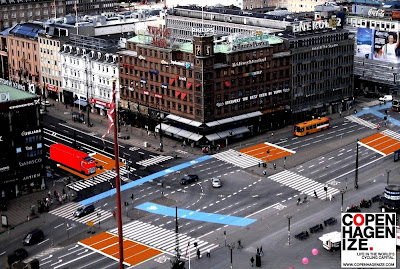
(Thanks to Mikael at Copenhagenize for his images, videos, and, well, leading the advocacy for this cause)
As part of my role as a commissioner on the Bicycle and Pedestrian Safety Commission, I have advocated for segregated bike lanes and identifiable paths (including colored lanes) that run through intersections. These measures would drastically increase the safety of bicyclists because they would be separated from traffic and more visible when crossing intersections.
Wouldn't it be nice if Bloominghagen looked like this?

(Thanks to Mikael at Copenhagenize for his images, videos, and, well, leading the advocacy for this cause)
Props for Bloomington
Let there be no doubt: much can be done to improve Bloomington's bike-ability. But, in my criticism, it may seem as if I believe that Bloomington has done nothing to promote a bicycling and pedestrian friendly city. To the contrary, for a small town in Indiana, Bloomington has done much. To wit, the amazing B-Line trail.

This trail, which will eventually link to a Rails-to-Trail south of the city, is on what used to be part of the Monon rail line. After phase 1, the paved trail goes from 2nd street to 11th Street, which is straight through downtown Bloomington. The highlight of the trail is right outside City Hall, where, every weekend, people converge on the Farmer's Market.
I'll just say it: I love the B-Line. It is beautiful. It is easy. It is fast. And since it opened late last Spring, I have seen tons of people use it to walk to shops, the farmer's market, and restaurants. I can easily hop on from my neighborhood, and in about 5 minutes be at my office. From my office, I can quickly walk on the B-Line to Bloomingfoods for lunch or dinner provisions. With the B-line, my commute is fast and safe, not to mention scenic.
Here are some photographs of the trail.
 Artwork on the B-Line.
 My other half (on the bike) stopping for breakfast at Le Petit Cafe's walk-up window.
 The Farmer's Market, on Saturday (above and below).
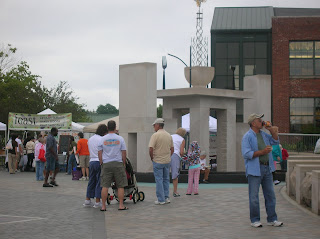

This trail, which will eventually link to a Rails-to-Trail south of the city, is on what used to be part of the Monon rail line. After phase 1, the paved trail goes from 2nd street to 11th Street, which is straight through downtown Bloomington. The highlight of the trail is right outside City Hall, where, every weekend, people converge on the Farmer's Market.
I'll just say it: I love the B-Line. It is beautiful. It is easy. It is fast. And since it opened late last Spring, I have seen tons of people use it to walk to shops, the farmer's market, and restaurants. I can easily hop on from my neighborhood, and in about 5 minutes be at my office. From my office, I can quickly walk on the B-Line to Bloomingfoods for lunch or dinner provisions. With the B-line, my commute is fast and safe, not to mention scenic.
Here are some photographs of the trail.
 Artwork on the B-Line.
 My other half (on the bike) stopping for breakfast at Le Petit Cafe's walk-up window.
 The Farmer's Market, on Saturday (above and below).
What Other Cities Do
Aside from a few select cities (Portland, OR, San Francisco, CA) in the United States, the idea of the bicycle as legitimate transport has not caught on. But this has not stopped even car-loving cities from trying to do something. On a recent (May) trip to St. Petersburg, Florida, I was completely shocked that this town, in an otherwise car-loving state, had put in segregated bike lanes. I adore segregated bike lanes. I wish Bloomington would create segregated bike lanes.
 Isn't this beautiful? The bicyclists travel down this lovely tree-lined lane, completely safe from car traffic and opening doors.

In St. Pete's, the lane has traffic going in both directions. I'm not sure how I feel about that, but it's better than nothing!

Here the lane crosses an intersection. You can see how bicycles are given a striped crosswalk, which helps bring bicyclists to the attention of motor-traffic. Bicyclists are given their own crossing light.

But, even with this great infrastructure, some still choose the "safer" sidewalk.
 Isn't this beautiful? The bicyclists travel down this lovely tree-lined lane, completely safe from car traffic and opening doors.
In St. Pete's, the lane has traffic going in both directions. I'm not sure how I feel about that, but it's better than nothing!

Here the lane crosses an intersection. You can see how bicycles are given a striped crosswalk, which helps bring bicyclists to the attention of motor-traffic. Bicyclists are given their own crossing light.

But, even with this great infrastructure, some still choose the "safer" sidewalk.
Parents and children
Bloomington parents enjoy taking rides with their children. Our bike culture is not as developed as certain Northern European countries, but we're getting there.


And this is the goal. I first saw this video on Copenhagenize. This is a typical morning in the Netherlands--parents dropping their kids off at school. As Copenhagenize says: normal people in normal clothes doing normal things on their bikes. Enjoy!


And this is the goal. I first saw this video on Copenhagenize. This is a typical morning in the Netherlands--parents dropping their kids off at school. As Copenhagenize says: normal people in normal clothes doing normal things on their bikes. Enjoy!
Commuting Through Bloomington Safely: Part I
Fear and a lack of safety are the most common reasons I hear for people not riding their bikes in Bloomington. And, really, I can't blame those who feel unsafe on Bloomington's roads. The town has not encouraged bicycling by incorporating bicycle infrastructure into its planning in any significant way.
The only bike lanes of consequence in town run on North-South roads. But a large number of residents live to the East and West of downtown. For those who live on the far East side of Bloomington, the only way to commute by bike to downtown would be to ride on the narrow and busy 10th and 3rd streets or to ride through Indiana University's campus (and, really, what adult wants to be reminded of the fact that the incoming freshman were born in 1990? As if aging weren't hard enough). IU's campus is not exactly the easiest to traverse on bike because there is no road that goes straight through campus (which makes, by the way, for a beautiful campus--just not thru-ride friendly). The solution, obviously, is to put bike lanes on Third and Tenth streets.
The same lack of infrastructure also exists for those on the far West, South, and North sides of Bloomington. Although the city planners have thrown the bicyclists a bone by putting in some bike lanes on Walnut and College (the two main thoroughfares), these lanes are inadequate and a joke. The two roads are among the busiest (and fastest) in town, yet the "bike lane" is really a "shared" lane for the several blocks around the square. I don't know about anyone else, but I don't feel like that lane is really "shared." Actually, I* have used the "shared" lane twice, and now avoid it like the plague.
On the North side of the square, running from around 10th street to 13th streets, on both College and Walnut, the city allows commuters a segregated (by a line) bike lane. Thank you city planners. Those few blocks--on one of the biggest hills in Bloomington--really come in handy.
 The bike lane on Walnut street at Walnut and Cottage Grove.
Let's get real here. Those lanes were added, not for the comfort of cyclists, and not to encourage bike-commuters, but to get cyclists off the planners back. Needless to say, I have rarely, seen another cyclist riding in those two lanes.
Bloomington also likes to make their existing bike lanes a bit confusing. Take the intersections on Lincoln and Third, Fourth, Fifth, and Sixth. Whereas, for most of Lincoln, the bike lane runs smoothly along the right-hand side of the road-

as it approaches Third Street, it disappears.


The road branches into two lanes, a straight and a turning, and, instead of providing a safe crossing over Third Street, cyclists are left to fend for themselves.
This happens again at the intersections of 4th and 6th streets.

 Lincoln Street bike lane disappearing at 4th street


 Lincoln Street bike lane picking up at Kirkwood and disappearing again at 6th street.
Clearly the people who planned these bike lanes were not bicyclists.
Figuring out what to do at these intersections is not instinctive. The first option is to keep going straight because the bike lane doesn't curve in anyway. But if the cyclist goes straight, then he finds himself to the right of cars that are turning--that is not a good place to be in a town where cars don't look out for bicyclists.
The second option is to move to the far left hand lane--the lane going straight. But, by doing this, the cyclist places herself right in front of traffic moving much faster than she can.
The third option, which is the best option out of the altogether-not-so-great-options, is to move between the two lanes (the straight lane and the turn lane). This is the option I choose. This way, I am visible to those going straight, but not in their way, and I will not die when the dump truck decides to turn right into me.
This option is problematic, as well, however, because the bike lane picks up again after the intersection on the right hand side. And, at fourth street, it disappears a second time. This means that the cyclist must constantly veer in and out of traffic if she wants to ride straight on Lincoln Street. Drivers become confused (especially if they need to move to the right of the cyclist now moving left because the cars want to turn right). Confused drivers are dangerous to cyclists.
As moving to the center is the safest option, it remains the best way to navigate these intersections, but we need a new plan.
Copenhagen, where at least 35% of the city commutes by bike each day, year round (another 30% takes public transportation), has developed solutions to a lack of visibility at intersections. Throughout the city, planners have instituted different types of bike lanes. Some bike lanes are separated by a low median between traffic and cars (which looks nice bricked over). Others are separated with a low, raised curb. A third separates cars from bicycle lanes with paint--this is the chosen method in Bloomington, although in Bloomington cars can park on the right of the cyclists, putting them in more danger of open doors; on some roads in Copenhagen, cars park on the left of the bike lanes.
Additional ways to increase visibility include painting bike lanes a different color. This is especially important for bike lanes as they approach and cross intersections. This photo from Copenhagenize shows how different colored intersections increase bicycle and pedestrian visibility.
With none of these safety solutions, Bloomington has a long way to go before bicyclists feel that they can safely ride through the city. The city needs to increase the numbers of bike lanes, and they need to make sure that the bike lanes are logical and safe. Painted lines help, but those lines offer a minimal amount of security. More lanes throughout the city in more logical places (particularly on the main East-West thoroughfares), lanes segregated by something more than a line, and painted lanes traveling through intersections would be a good start.
Here are two ideas for making bike-safe cities:
Livable Copenhagen
Bicycle Blueprint (New York City)
*And I should note here, that I have used a bicycle as my primary mode of transportation since I was 13. I raced for several years, know much about bike safety, and have mad bike handling skills. Yet I feel incredibly unsafe on those roads).
The only bike lanes of consequence in town run on North-South roads. But a large number of residents live to the East and West of downtown. For those who live on the far East side of Bloomington, the only way to commute by bike to downtown would be to ride on the narrow and busy 10th and 3rd streets or to ride through Indiana University's campus (and, really, what adult wants to be reminded of the fact that the incoming freshman were born in 1990? As if aging weren't hard enough). IU's campus is not exactly the easiest to traverse on bike because there is no road that goes straight through campus (which makes, by the way, for a beautiful campus--just not thru-ride friendly). The solution, obviously, is to put bike lanes on Third and Tenth streets.
The same lack of infrastructure also exists for those on the far West, South, and North sides of Bloomington. Although the city planners have thrown the bicyclists a bone by putting in some bike lanes on Walnut and College (the two main thoroughfares), these lanes are inadequate and a joke. The two roads are among the busiest (and fastest) in town, yet the "bike lane" is really a "shared" lane for the several blocks around the square. I don't know about anyone else, but I don't feel like that lane is really "shared." Actually, I* have used the "shared" lane twice, and now avoid it like the plague.
On the North side of the square, running from around 10th street to 13th streets, on both College and Walnut, the city allows commuters a segregated (by a line) bike lane. Thank you city planners. Those few blocks--on one of the biggest hills in Bloomington--really come in handy.
 The bike lane on Walnut street at Walnut and Cottage Grove.
Let's get real here. Those lanes were added, not for the comfort of cyclists, and not to encourage bike-commuters, but to get cyclists off the planners back. Needless to say, I have rarely, seen another cyclist riding in those two lanes.
Bloomington also likes to make their existing bike lanes a bit confusing. Take the intersections on Lincoln and Third, Fourth, Fifth, and Sixth. Whereas, for most of Lincoln, the bike lane runs smoothly along the right-hand side of the road-

as it approaches Third Street, it disappears.


The road branches into two lanes, a straight and a turning, and, instead of providing a safe crossing over Third Street, cyclists are left to fend for themselves.
This happens again at the intersections of 4th and 6th streets.

 Lincoln Street bike lane disappearing at 4th street

 Lincoln Street bike lane picking up at Kirkwood and disappearing again at 6th street.
Clearly the people who planned these bike lanes were not bicyclists.
Figuring out what to do at these intersections is not instinctive. The first option is to keep going straight because the bike lane doesn't curve in anyway. But if the cyclist goes straight, then he finds himself to the right of cars that are turning--that is not a good place to be in a town where cars don't look out for bicyclists.
The second option is to move to the far left hand lane--the lane going straight. But, by doing this, the cyclist places herself right in front of traffic moving much faster than she can.
The third option, which is the best option out of the altogether-not-so-great-options, is to move between the two lanes (the straight lane and the turn lane). This is the option I choose. This way, I am visible to those going straight, but not in their way, and I will not die when the dump truck decides to turn right into me.
This option is problematic, as well, however, because the bike lane picks up again after the intersection on the right hand side. And, at fourth street, it disappears a second time. This means that the cyclist must constantly veer in and out of traffic if she wants to ride straight on Lincoln Street. Drivers become confused (especially if they need to move to the right of the cyclist now moving left because the cars want to turn right). Confused drivers are dangerous to cyclists.
As moving to the center is the safest option, it remains the best way to navigate these intersections, but we need a new plan.
Copenhagen, where at least 35% of the city commutes by bike each day, year round (another 30% takes public transportation), has developed solutions to a lack of visibility at intersections. Throughout the city, planners have instituted different types of bike lanes. Some bike lanes are separated by a low median between traffic and cars (which looks nice bricked over). Others are separated with a low, raised curb. A third separates cars from bicycle lanes with paint--this is the chosen method in Bloomington, although in Bloomington cars can park on the right of the cyclists, putting them in more danger of open doors; on some roads in Copenhagen, cars park on the left of the bike lanes.
Additional ways to increase visibility include painting bike lanes a different color. This is especially important for bike lanes as they approach and cross intersections. This photo from Copenhagenize shows how different colored intersections increase bicycle and pedestrian visibility.
With none of these safety solutions, Bloomington has a long way to go before bicyclists feel that they can safely ride through the city. The city needs to increase the numbers of bike lanes, and they need to make sure that the bike lanes are logical and safe. Painted lines help, but those lines offer a minimal amount of security. More lanes throughout the city in more logical places (particularly on the main East-West thoroughfares), lanes segregated by something more than a line, and painted lanes traveling through intersections would be a good start.
Here are two ideas for making bike-safe cities:
Livable Copenhagen
Bicycle Blueprint (New York City)
*And I should note here, that I have used a bicycle as my primary mode of transportation since I was 13. I raced for several years, know much about bike safety, and have mad bike handling skills. Yet I feel incredibly unsafe on those roads).
Another take on a bicycle culture
Bloomington's bike culture may just be budding, but other cities throughout the world have long had a society based around the bicycle. One of those is Copenhagen, Denmark, whose bike culture is well known. From Copenhagen comes the amazing blog, Copenhagenize devoted to inspiring other places around the world.
The author, Zakkalicious, has proposed, somewhat tongue-in-cheek, 18 ways a society can know that it has a bike culture. Here they are:
1. ”Fixed gear” is something than happens after you take your old Raleigh down to one of the 20-30 bike shops in your neighbourhood to have them look at ”broken gear”.
2. If a car honks at you in traffic, you hardly notice. Instead it makes you think that it's been a while since you took your kids to the park to feed the ducks... Hmmm... maybe this Sunday?
 3. You think nothing of riding home in 35 degree heat, with your four year-old on the bike seat, two bags of groceries dangling on your handlebars, talking to your partner on the phone about dinner - all the while heading up a steep hill and STILL being able to growl ”Stay on the right!” in three languages at the weaving, gasping tourists on their rental bikes whom you just flew past as though they were carved in stone.
 4. When you feel yourself start sweating on the bike lanes on your way to work... you just ride slower. And if the forecast is for hot weather, you leave for work a bit earlier so you don't have to ride so fast and get too sweaty.
5. The only place you ever see Lycra or spandex is in old Jane Fonda workout videos or on joggers in the parks.
6. And you're quite sure that Gortex is that guy who plays midfield for Bayern München.
 7. When your bike breaks down and is in for repairs you take your other bike, or you take the train or bus. Even though your car is parked out front.
8. The only time you see more than three cyclists in one place wearing helmets is every July - on the television during the Tour de France.
9. The odd-person out in your circle of friends is the one who has never fallen off their bike while riding home drunk. You mock him/her regularly.
 10. You have, at one time or another, checked to see if your clothes match your bike.
11. You and your friends have repeated discussions about which bike repair shop in your neighbourhood is the best for price and service.
12. When you see somebody with rolled up trouser legs you think, ”what a shame that fellow can't afford a chain guard”. You consider rolling up next to him at the next light to give him some money.
 13. You don't even know that you live in a ”bike culture” and have never used the expression. You just ride.
 14. You use your time waiting at a red light in bicycle rush hour with over 100 other cyclists to check out new fashions. ”Wonder where she got those shoes? Cool sunglasses on that guy... must be Prada.”
 15. Your entire wardrobe can be classified as ”cycle wear”. Espeically those stilettos from Christian Louboutin or your new double-breasted trenchcoast from Tiger of Sweden.
16. When the odd motorist cuts you off you fix him with an icy stare and shake your head in pity before riding off and forgetting the whole episode 50 metres farther down the bike lane.
 17. You find rust on bicycles to be charming and aesthetic. Shiny new bikes are somehow gaudy.
 18. It takes you over fifteen minutes to find your parked bike at the train station.
The author, Zakkalicious, has proposed, somewhat tongue-in-cheek, 18 ways a society can know that it has a bike culture. Here they are:
1. ”Fixed gear” is something than happens after you take your old Raleigh down to one of the 20-30 bike shops in your neighbourhood to have them look at ”broken gear”.
2. If a car honks at you in traffic, you hardly notice. Instead it makes you think that it's been a while since you took your kids to the park to feed the ducks... Hmmm... maybe this Sunday?
 3. You think nothing of riding home in 35 degree heat, with your four year-old on the bike seat, two bags of groceries dangling on your handlebars, talking to your partner on the phone about dinner - all the while heading up a steep hill and STILL being able to growl ”Stay on the right!” in three languages at the weaving, gasping tourists on their rental bikes whom you just flew past as though they were carved in stone.
 4. When you feel yourself start sweating on the bike lanes on your way to work... you just ride slower. And if the forecast is for hot weather, you leave for work a bit earlier so you don't have to ride so fast and get too sweaty.
5. The only place you ever see Lycra or spandex is in old Jane Fonda workout videos or on joggers in the parks.
6. And you're quite sure that Gortex is that guy who plays midfield for Bayern München.
 7. When your bike breaks down and is in for repairs you take your other bike, or you take the train or bus. Even though your car is parked out front.
8. The only time you see more than three cyclists in one place wearing helmets is every July - on the television during the Tour de France.
9. The odd-person out in your circle of friends is the one who has never fallen off their bike while riding home drunk. You mock him/her regularly.
 10. You have, at one time or another, checked to see if your clothes match your bike.
11. You and your friends have repeated discussions about which bike repair shop in your neighbourhood is the best for price and service.
12. When you see somebody with rolled up trouser legs you think, ”what a shame that fellow can't afford a chain guard”. You consider rolling up next to him at the next light to give him some money.
 13. You don't even know that you live in a ”bike culture” and have never used the expression. You just ride.
 14. You use your time waiting at a red light in bicycle rush hour with over 100 other cyclists to check out new fashions. ”Wonder where she got those shoes? Cool sunglasses on that guy... must be Prada.”
 15. Your entire wardrobe can be classified as ”cycle wear”. Espeically those stilettos from Christian Louboutin or your new double-breasted trenchcoast from Tiger of Sweden.
16. When the odd motorist cuts you off you fix him with an icy stare and shake your head in pity before riding off and forgetting the whole episode 50 metres farther down the bike lane.
 17. You find rust on bicycles to be charming and aesthetic. Shiny new bikes are somehow gaudy.
 18. It takes you over fifteen minutes to find your parked bike at the train station.
Subscribe to:
Posts (Atom)