Showing posts with label commuting. Show all posts
A Bike Culture
Props for Bloomington
Let there be no doubt: much can be done to improve Bloomington's bike-ability. But, in my criticism, it may seem as if I believe that Bloomington has done nothing to promote a bicycling and pedestrian friendly city. To the contrary, for a small town in Indiana, Bloomington has done much. To wit, the amazing B-Line trail.

This trail, which will eventually link to a Rails-to-Trail south of the city, is on what used to be part of the Monon rail line. After phase 1, the paved trail goes from 2nd street to 11th Street, which is straight through downtown Bloomington. The highlight of the trail is right outside City Hall, where, every weekend, people converge on the Farmer's Market.
I'll just say it: I love the B-Line. It is beautiful. It is easy. It is fast. And since it opened late last Spring, I have seen tons of people use it to walk to shops, the farmer's market, and restaurants. I can easily hop on from my neighborhood, and in about 5 minutes be at my office. From my office, I can quickly walk on the B-Line to Bloomingfoods for lunch or dinner provisions. With the B-line, my commute is fast and safe, not to mention scenic.
Here are some photographs of the trail.
Artwork on the B-Line.
My other half (on the bike) stopping for breakfast at Le Petit Cafe's walk-up window.
The Farmer's Market, on Saturday (above and below).
This trail, which will eventually link to a Rails-to-Trail south of the city, is on what used to be part of the Monon rail line. After phase 1, the paved trail goes from 2nd street to 11th Street, which is straight through downtown Bloomington. The highlight of the trail is right outside City Hall, where, every weekend, people converge on the Farmer's Market.
I'll just say it: I love the B-Line. It is beautiful. It is easy. It is fast. And since it opened late last Spring, I have seen tons of people use it to walk to shops, the farmer's market, and restaurants. I can easily hop on from my neighborhood, and in about 5 minutes be at my office. From my office, I can quickly walk on the B-Line to Bloomingfoods for lunch or dinner provisions. With the B-line, my commute is fast and safe, not to mention scenic.
Here are some photographs of the trail.
Risky Business
To don, or not to don (helmets), that is the question.


Some additional reads:
Dutch Cycling Union's Position
Icelandic Cycling Union's Position
European Cycling Federation's Position
Helmet use for Pedestrians
Seat Belts vs. Helmets
For many people, the instinctive response is to don. And not just to make that personal choice, but to lecture heavily those who do not. But are helmets the ultimate safety gear, or do they offer only the perception of safety? You may be surprised at the answer.
Over the last several years (or 20 or so), helmets have been promoted and in many cases have been mandated. Promotion of helmets has been backed with statistics about the number of head injuries or how many deaths are prevented with the light piece of plastic on one's head or anecdotal evidence of so-and-so who almost died and surely would have had he not been wearing his helmet.
Unfortunately, the data are not that clear. Research has not shown definitively that helmets save lives. The evidence, researchers have found, is inconclusive and contradictory. Part of the problem is the difficulty of doing studies on cyclists. Bicycling, in general, is not a risky endeavor, and very few injuries result, particularly compared to pedestrians and motorists.
Moreover, helmet-related studies have often been "case-controlled" studies, which compare a group of cyclists who had head injuries and one or more groups without head injuries. The problem with these types of studies is that suitable control groups are not always available. Other problems include the difficulty of adjusting for other differences between the head injury group and the non-head injury group (aside from the difference the researchers are looking for: helmet use). Studies have shown that cyclists who wear helmets may be more safety-conscious and follow the rules, which would result in fewer injuries (although, other studies have shown that they also tend to crash more). Also, in one study, helmet-wearers tended to be adult and female (and more responsible) and the non-helmet wearers were children and male (and more likely to take risks).
Another common study, the time-trend analysis, studies injuries over time in places where helmet use is required. The benefit of these types of studies seems to be debatable, as scientists do not agree on the criteria that should be used.
Additionally problematic are the anecdotal evidence ("My life was saved by a bicycle helmet."). Well, it's really quite difficult to say that for sure, isn't it?
In fact, for the casual, commuting or recreational cyclist, the studies do not demonstrate that helmets prevent head injuries. Helmets will, at most, prevent head injuries for high speed crashes of the sort that occur in bike races. At lower speeds, which is the speed most people ride around town, most cyclists will fall and hit their arms or their legs. Furthermore, in an accident with a car, no bicycle helmet will help--they aren't designed to.
(Here is a piece of anecdotal evidence. In the years I raced competitively--not including triathlons--1993-1999, I went to the hospital 3 times for bike wrecks, including a high speed wreck in a race where I slid across the road and hit the opposite curb with my back. I also had many, many other additional crashes. Not once did I have a head injury. But both my hips and knees still carry remnants of asphalt)
The thing we have learned is that mandating helmet use seems to make cycling safer in one way: it discourages people from riding their bikes. If you don't ride your bike, you can't hurt your head in a bike wreck. At least one study (pdf) has found that when helmet laws were mandated in Australia, a significant number of people stopped riding.
Studies of other mandated helmet laws found similar trends--that the number of head injuries declined, but so did the number of other non-head injuries, meaning that the reduction of head injuries was probably related to a reduction in bicyclists. Teenagers, in particular, were more apt to abandon the bike. Helmets are hot and sticky, and they are difficult to secure to a bicycle when the bicycle is parked (the other, more annoying, option being hauling the helmet with you). These are disincentives to wearing a helmet, and, when helmets are mandated, a disincentive to riding a bike.
AND fewer people on the roads actually make it more dangerous for others, as there is safety in numbers.
As the helmet debate probably will not provide a conclusive answer anytime soon, advocates of safe cycling need to focus on the real dangers cyclist face: the automobile. Instead of requiring cyclists to don a helmet, cities should provide the infrastructure to protect cyclists from cars and to make cars aware of cyclists' presence. This includes providing more and better bike lanes that are segregated from traffic; painting those lanes that cross intersections bright, bold colors so drivers can see bike lanes and cyclists; and creating separate turning lanes for cyclists. Additional education for young riders on safety rules would help them protect themselves in traffic.
Bicycling is a healthy mode of transportation. Getting more people on bikes could help clear the air of pollution and minimize our ever-expanding waistlines. Preaching about helmet usage, however, has the opposite effect. It makes cycling seem dangerous when it really isn't. Helmets have not been found to provide the safety that their promoters declare, and such preachiness will only serve to reduce the numbers of people getting out on their bikes. Helmet usage should remain a personal decision (so thank you for no longer preaching to me).
Over the last several years (or 20 or so), helmets have been promoted and in many cases have been mandated. Promotion of helmets has been backed with statistics about the number of head injuries or how many deaths are prevented with the light piece of plastic on one's head or anecdotal evidence of so-and-so who almost died and surely would have had he not been wearing his helmet.
Unfortunately, the data are not that clear. Research has not shown definitively that helmets save lives. The evidence, researchers have found, is inconclusive and contradictory. Part of the problem is the difficulty of doing studies on cyclists. Bicycling, in general, is not a risky endeavor, and very few injuries result, particularly compared to pedestrians and motorists.
Moreover, helmet-related studies have often been "case-controlled" studies, which compare a group of cyclists who had head injuries and one or more groups without head injuries. The problem with these types of studies is that suitable control groups are not always available. Other problems include the difficulty of adjusting for other differences between the head injury group and the non-head injury group (aside from the difference the researchers are looking for: helmet use). Studies have shown that cyclists who wear helmets may be more safety-conscious and follow the rules, which would result in fewer injuries (although, other studies have shown that they also tend to crash more). Also, in one study, helmet-wearers tended to be adult and female (and more responsible) and the non-helmet wearers were children and male (and more likely to take risks).
Another common study, the time-trend analysis, studies injuries over time in places where helmet use is required. The benefit of these types of studies seems to be debatable, as scientists do not agree on the criteria that should be used.
Additionally problematic are the anecdotal evidence ("My life was saved by a bicycle helmet."). Well, it's really quite difficult to say that for sure, isn't it?
In fact, for the casual, commuting or recreational cyclist, the studies do not demonstrate that helmets prevent head injuries. Helmets will, at most, prevent head injuries for high speed crashes of the sort that occur in bike races. At lower speeds, which is the speed most people ride around town, most cyclists will fall and hit their arms or their legs. Furthermore, in an accident with a car, no bicycle helmet will help--they aren't designed to.
(Here is a piece of anecdotal evidence. In the years I raced competitively--not including triathlons--1993-1999, I went to the hospital 3 times for bike wrecks, including a high speed wreck in a race where I slid across the road and hit the opposite curb with my back. I also had many, many other additional crashes. Not once did I have a head injury. But both my hips and knees still carry remnants of asphalt)
The thing we have learned is that mandating helmet use seems to make cycling safer in one way: it discourages people from riding their bikes. If you don't ride your bike, you can't hurt your head in a bike wreck. At least one study (pdf) has found that when helmet laws were mandated in Australia, a significant number of people stopped riding.
Studies of other mandated helmet laws found similar trends--that the number of head injuries declined, but so did the number of other non-head injuries, meaning that the reduction of head injuries was probably related to a reduction in bicyclists. Teenagers, in particular, were more apt to abandon the bike. Helmets are hot and sticky, and they are difficult to secure to a bicycle when the bicycle is parked (the other, more annoying, option being hauling the helmet with you). These are disincentives to wearing a helmet, and, when helmets are mandated, a disincentive to riding a bike.
AND fewer people on the roads actually make it more dangerous for others, as there is safety in numbers.
As the helmet debate probably will not provide a conclusive answer anytime soon, advocates of safe cycling need to focus on the real dangers cyclist face: the automobile. Instead of requiring cyclists to don a helmet, cities should provide the infrastructure to protect cyclists from cars and to make cars aware of cyclists' presence. This includes providing more and better bike lanes that are segregated from traffic; painting those lanes that cross intersections bright, bold colors so drivers can see bike lanes and cyclists; and creating separate turning lanes for cyclists. Additional education for young riders on safety rules would help them protect themselves in traffic.
Bicycling is a healthy mode of transportation. Getting more people on bikes could help clear the air of pollution and minimize our ever-expanding waistlines. Preaching about helmet usage, however, has the opposite effect. It makes cycling seem dangerous when it really isn't. Helmets have not been found to provide the safety that their promoters declare, and such preachiness will only serve to reduce the numbers of people getting out on their bikes. Helmet usage should remain a personal decision (so thank you for no longer preaching to me).
Dutch Cycling Union's Position
Icelandic Cycling Union's Position
European Cycling Federation's Position
Helmet use for Pedestrians
Seat Belts vs. Helmets
Saturday: Farmer's Market
One of the greatest things about Bloomington, if not the greatest, is its Saturday Farmer's Market. The Market lasts from the first weekend in April until the end of November (outside), then picks up again (inside) from the end of January until the end of March.
The market is the largest in the state, and it is an event. Each week vendors from around the area (some traveling upwards of 2 hours to sell their products) set up shop and offer a wide range of food from grassfed meats, to baked goods, to plants, to every kind of seasonal vegetable you can imagine. The key is that the seller has to have grown/produced the product himself, thus, the food is most definitely local and seasonal. We even are lucky enough to have cheeses from the famous Capriole farm.
Every Saturday also offers a different musical event (with street musicians interspersed throughout the market). The market is the place to see and be seen (and to get delicious food that you can't get anywhere else. California tomatoes just can't compare). It is also a good place to see people on bikes.
Heading to the market. Ready to load up the backpack.
People of all ages spend their Saturday mornings at the market. Young college students come by and see their friends; parents bring their children; and yuppies and elderly folk also shop the stalls. By 10 o'clock, it can be difficult to navigate the large crowds.
Most people still head to the market by car, but the number of bicycles seems to increase from week to week.
These friends were heading to the market, riding in a row, together.
Girl in dress, leaving the market.
The market is not the place to see stylish people. The style of dress is more what I would call "farmer's market casual," meaning that most people look as if they picked up whatever was last dropped on their floors. Anyone dressed any nicer certainly warrants stares.
What you do see at the market are the increasingly common back-cargo hold for children. This seems to be the tote of choice for biking-parents with children:

My other favorite sight--and perhaps one of the most convenient ways to haul the large bags of produce--is the Milk Crate. An unusually large number of bicyclists put these crates on the backs of their bikes to increase the cargo-load capacity of their bicycles (we are not quite at the level of Copenhagen and Amsterdam where people have real cargo-bikes). You can see one example above. Here are some more:


The market is the largest in the state, and it is an event. Each week vendors from around the area (some traveling upwards of 2 hours to sell their products) set up shop and offer a wide range of food from grassfed meats, to baked goods, to plants, to every kind of seasonal vegetable you can imagine. The key is that the seller has to have grown/produced the product himself, thus, the food is most definitely local and seasonal. We even are lucky enough to have cheeses from the famous Capriole farm.
Every Saturday also offers a different musical event (with street musicians interspersed throughout the market). The market is the place to see and be seen (and to get delicious food that you can't get anywhere else. California tomatoes just can't compare). It is also a good place to see people on bikes.
People of all ages spend their Saturday mornings at the market. Young college students come by and see their friends; parents bring their children; and yuppies and elderly folk also shop the stalls. By 10 o'clock, it can be difficult to navigate the large crowds.
Most people still head to the market by car, but the number of bicycles seems to increase from week to week.
The market is not the place to see stylish people. The style of dress is more what I would call "farmer's market casual," meaning that most people look as if they picked up whatever was last dropped on their floors. Anyone dressed any nicer certainly warrants stares.
What you do see at the market are the increasingly common back-cargo hold for children. This seems to be the tote of choice for biking-parents with children:
Friday Round Up
Commuting Through Bloomington Safely: Part I
Fear and a lack of safety are the most common reasons I hear for people not riding their bikes in Bloomington. And, really, I can't blame those who feel unsafe on Bloomington's roads. The town has not encouraged bicycling by incorporating bicycle infrastructure into its planning in any significant way.
The only bike lanes of consequence in town run on North-South roads. But a large number of residents live to the East and West of downtown. For those who live on the far East side of Bloomington, the only way to commute by bike to downtown would be to ride on the narrow and busy 10th and 3rd streets or to ride through Indiana University's campus (and, really, what adult wants to be reminded of the fact that the incoming freshman were born in 1990? As if aging weren't hard enough). IU's campus is not exactly the easiest to traverse on bike because there is no road that goes straight through campus (which makes, by the way, for a beautiful campus--just not thru-ride friendly). The solution, obviously, is to put bike lanes on Third and Tenth streets.
The same lack of infrastructure also exists for those on the far West, South, and North sides of Bloomington. Although the city planners have thrown the bicyclists a bone by putting in some bike lanes on Walnut and College (the two main thoroughfares), these lanes are inadequate and a joke. The two roads are among the busiest (and fastest) in town, yet the "bike lane" is really a "shared" lane for the several blocks around the square. I don't know about anyone else, but I don't feel like that lane is really "shared." Actually, I* have used the "shared" lane twice, and now avoid it like the plague.
On the North side of the square, running from around 10th street to 13th streets, on both College and Walnut, the city allows commuters a segregated (by a line) bike lane. Thank you city planners. Those few blocks--on one of the biggest hills in Bloomington--really come in handy.
The bike lane on Walnut street at Walnut and Cottage Grove.
Let's get real here. Those lanes were added, not for the comfort of cyclists, and not to encourage bike-commuters, but to get cyclists off the planners back. Needless to say, I have rarely, seen another cyclist riding in those two lanes.
Bloomington also likes to make their existing bike lanes a bit confusing. Take the intersections on Lincoln and Third, Fourth, Fifth, and Sixth. Whereas, for most of Lincoln, the bike lane runs smoothly along the right-hand side of the road-

as it approaches Third Street, it disappears.


The road branches into two lanes, a straight and a turning, and, instead of providing a safe crossing over Third Street, cyclists are left to fend for themselves.
This happens again at the intersections of 4th and 6th streets.

Lincoln Street bike lane disappearing at 4th street


Lincoln Street bike lane picking up at Kirkwood and disappearing again at 6th street.
Clearly the people who planned these bike lanes were not bicyclists.
Figuring out what to do at these intersections is not instinctive. The first option is to keep going straight because the bike lane doesn't curve in anyway. But if the cyclist goes straight, then he finds himself to the right of cars that are turning--that is not a good place to be in a town where cars don't look out for bicyclists.
The second option is to move to the far left hand lane--the lane going straight. But, by doing this, the cyclist places herself right in front of traffic moving much faster than she can.
The third option, which is the best option out of the altogether-not-so-great-options, is to move between the two lanes (the straight lane and the turn lane). This is the option I choose. This way, I am visible to those going straight, but not in their way, and I will not die when the dump truck decides to turn right into me.
This option is problematic, as well, however, because the bike lane picks up again after the intersection on the right hand side. And, at fourth street, it disappears a second time. This means that the cyclist must constantly veer in and out of traffic if she wants to ride straight on Lincoln Street. Drivers become confused (especially if they need to move to the right of the cyclist now moving left because the cars want to turn right). Confused drivers are dangerous to cyclists.
As moving to the center is the safest option, it remains the best way to navigate these intersections, but we need a new plan.
Copenhagen, where at least 35% of the city commutes by bike each day, year round (another 30% takes public transportation), has developed solutions to a lack of visibility at intersections. Throughout the city, planners have instituted different types of bike lanes. Some bike lanes are separated by a low median between traffic and cars (which looks nice bricked over). Others are separated with a low, raised curb. A third separates cars from bicycle lanes with paint--this is the chosen method in Bloomington, although in Bloomington cars can park on the right of the cyclists, putting them in more danger of open doors; on some roads in Copenhagen, cars park on the left of the bike lanes.
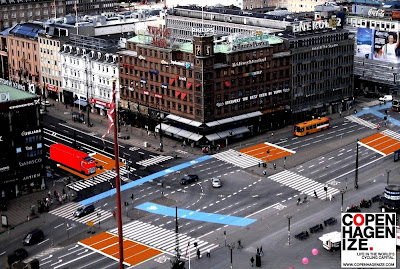
Additional ways to increase visibility include painting bike lanes a different color. This is especially important for bike lanes as they approach and cross intersections. This photo from Copenhagenize shows how different colored intersections increase bicycle and pedestrian visibility.

With none of these safety solutions, Bloomington has a long way to go before bicyclists feel that they can safely ride through the city. The city needs to increase the numbers of bike lanes, and they need to make sure that the bike lanes are logical and safe. Painted lines help, but those lines offer a minimal amount of security. More lanes throughout the city in more logical places (particularly on the main East-West thoroughfares), lanes segregated by something more than a line, and painted lanes traveling through intersections would be a good start.
Here are two ideas for making bike-safe cities:
Livable Copenhagen
Bicycle Blueprint (New York City)
*And I should note here, that I have used a bicycle as my primary mode of transportation since I was 13. I raced for several years, know much about bike safety, and have mad bike handling skills. Yet I feel incredibly unsafe on those roads).
The only bike lanes of consequence in town run on North-South roads. But a large number of residents live to the East and West of downtown. For those who live on the far East side of Bloomington, the only way to commute by bike to downtown would be to ride on the narrow and busy 10th and 3rd streets or to ride through Indiana University's campus (and, really, what adult wants to be reminded of the fact that the incoming freshman were born in 1990? As if aging weren't hard enough). IU's campus is not exactly the easiest to traverse on bike because there is no road that goes straight through campus (which makes, by the way, for a beautiful campus--just not thru-ride friendly). The solution, obviously, is to put bike lanes on Third and Tenth streets.
The same lack of infrastructure also exists for those on the far West, South, and North sides of Bloomington. Although the city planners have thrown the bicyclists a bone by putting in some bike lanes on Walnut and College (the two main thoroughfares), these lanes are inadequate and a joke. The two roads are among the busiest (and fastest) in town, yet the "bike lane" is really a "shared" lane for the several blocks around the square. I don't know about anyone else, but I don't feel like that lane is really "shared." Actually, I* have used the "shared" lane twice, and now avoid it like the plague.
On the North side of the square, running from around 10th street to 13th streets, on both College and Walnut, the city allows commuters a segregated (by a line) bike lane. Thank you city planners. Those few blocks--on one of the biggest hills in Bloomington--really come in handy.
Let's get real here. Those lanes were added, not for the comfort of cyclists, and not to encourage bike-commuters, but to get cyclists off the planners back. Needless to say, I have rarely, seen another cyclist riding in those two lanes.
Bloomington also likes to make their existing bike lanes a bit confusing. Take the intersections on Lincoln and Third, Fourth, Fifth, and Sixth. Whereas, for most of Lincoln, the bike lane runs smoothly along the right-hand side of the road-
as it approaches Third Street, it disappears.
The road branches into two lanes, a straight and a turning, and, instead of providing a safe crossing over Third Street, cyclists are left to fend for themselves.
This happens again at the intersections of 4th and 6th streets.
Clearly the people who planned these bike lanes were not bicyclists.
Figuring out what to do at these intersections is not instinctive. The first option is to keep going straight because the bike lane doesn't curve in anyway. But if the cyclist goes straight, then he finds himself to the right of cars that are turning--that is not a good place to be in a town where cars don't look out for bicyclists.
The second option is to move to the far left hand lane--the lane going straight. But, by doing this, the cyclist places herself right in front of traffic moving much faster than she can.
The third option, which is the best option out of the altogether-not-so-great-options, is to move between the two lanes (the straight lane and the turn lane). This is the option I choose. This way, I am visible to those going straight, but not in their way, and I will not die when the dump truck decides to turn right into me.
This option is problematic, as well, however, because the bike lane picks up again after the intersection on the right hand side. And, at fourth street, it disappears a second time. This means that the cyclist must constantly veer in and out of traffic if she wants to ride straight on Lincoln Street. Drivers become confused (especially if they need to move to the right of the cyclist now moving left because the cars want to turn right). Confused drivers are dangerous to cyclists.
As moving to the center is the safest option, it remains the best way to navigate these intersections, but we need a new plan.
Copenhagen, where at least 35% of the city commutes by bike each day, year round (another 30% takes public transportation), has developed solutions to a lack of visibility at intersections. Throughout the city, planners have instituted different types of bike lanes. Some bike lanes are separated by a low median between traffic and cars (which looks nice bricked over). Others are separated with a low, raised curb. A third separates cars from bicycle lanes with paint--this is the chosen method in Bloomington, although in Bloomington cars can park on the right of the cyclists, putting them in more danger of open doors; on some roads in Copenhagen, cars park on the left of the bike lanes.
Additional ways to increase visibility include painting bike lanes a different color. This is especially important for bike lanes as they approach and cross intersections. This photo from Copenhagenize shows how different colored intersections increase bicycle and pedestrian visibility.

With none of these safety solutions, Bloomington has a long way to go before bicyclists feel that they can safely ride through the city. The city needs to increase the numbers of bike lanes, and they need to make sure that the bike lanes are logical and safe. Painted lines help, but those lines offer a minimal amount of security. More lanes throughout the city in more logical places (particularly on the main East-West thoroughfares), lanes segregated by something more than a line, and painted lanes traveling through intersections would be a good start.
Here are two ideas for making bike-safe cities:
Livable Copenhagen
Bicycle Blueprint (New York City)
*And I should note here, that I have used a bicycle as my primary mode of transportation since I was 13. I raced for several years, know much about bike safety, and have mad bike handling skills. Yet I feel incredibly unsafe on those roads).
Subscribe to:
Posts (Atom)
